Rio Grande Valley · Year-round Resident
Couch's Kingbird
Tyrannus couchii · Tirano de Couch
Resident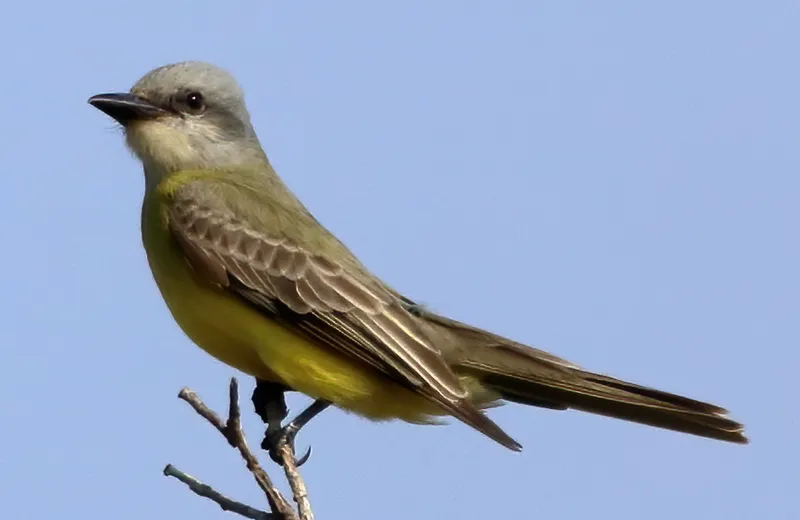
Photo: Wikimedia Commons
Overview
Couch's Kingbird is the quintessential large flycatcher of the lower Rio Grande Valley — found in virtually every park, garden, woodland edge, and roadside tree throughout the region. It was long lumped with the Tropical Kingbird as a single species; the two were split in 1983 based on call differences, range, and subtle plumage distinctions. In the Valley, Couch's is by far the more abundant of the two and is the default large yellow kingbird you will encounter at any RGV stop.
Identification
A large flycatcher with gray head, olive-green back, white throat, and bright yellow underparts. The bill is heavy and slightly hooked. The tail is notched (slightly forked) and brown without rufous edges — the most reliable visual distinction from the Tropical Kingbird, which shows a more deeply notched tail with a brownish-gray tone.
In practice, the call is the surest way to separate the two: Couch's gives a rolling, nasal breeeer or kip-breeeer; the Tropical Kingbird produces a rapid, high-pitched twittering pip series. Any large yellow kingbird calling clearly can be identified by ear in seconds.
Habitat & Range
Couch's Kingbirds occupy a wide range of open and semi-open habitats — woodland edges, riparian corridors, roadsides, towns, parks, and suburban gardens with large trees. They readily adapt to human-altered landscapes and are among the most conspicuous birds in any RGV community.
The U.S. range is essentially limited to the lower Rio Grande Valley. The species is more widespread in Mexico, where it inhabits lowland forest edges and open country from the U.S. border south through the Yucatán Peninsula.
Behavior & Diet
Like all kingbirds, Couch's is an aerial insectivore that sallies from a conspicuous perch to catch flying insects, returning to the same perch or a nearby one. Diet is primarily large insects — beetles, grasshoppers, wasps, and dragonflies — supplemented by berries and small fruits in season.
Kingbirds are famously aggressive in defense of nest and territory, readily mobbing and chasing much larger birds including hawks, herons, and crows. Nests are built in trees, often at moderate heights in parks or along roadsides. Both parents share incubation and chick-rearing duties.
Where to See in South Texas
Quinta Mazatlán
McAllen
National Butterfly Center
Mission
Santa Ana National Wildlife Refuge
Alamo
Bentsen-Rio Grande Valley State Park
Mission
Effectively impossible to miss anywhere in the Valley. If you see a large yellow flycatcher on a wire or treetop in the RGV, it is almost certainly this species.
Best Time to See
Year-round — Couch's Kingbird is permanently resident in the Rio Grande Valley and one of the easiest birds to find on any visit. Any exposed perch — power lines, treetops, fence posts near open areas — is a potential Couch's Kingbird lookout. The loud, nasal breeeer call carries well and the birds are conspicuous and bold. Numbers increase somewhat in spring and summer when breeding activity is highest, but this species is reliably present 365 days a year.
Conservation Status
IUCN: Least ConcernCommon and stable. The species adapts well to suburban and agricultural environments and shows no signs of population decline. Its versatility in habitat use makes it one of the more resilient birds in the Valley.
Fun Fact
Couch's Kingbird is named for Darius Nash Couch, a U.S. Army officer and naturalist who collected the type specimen in Tamaulipas, Mexico, in the 1850s. The species was described by Spencer Fullerton Baird in 1858 — then spent 125 years lumped with the Tropical Kingbird before being recognized as a distinct species based on differences in vocalizations and range.
In the News